
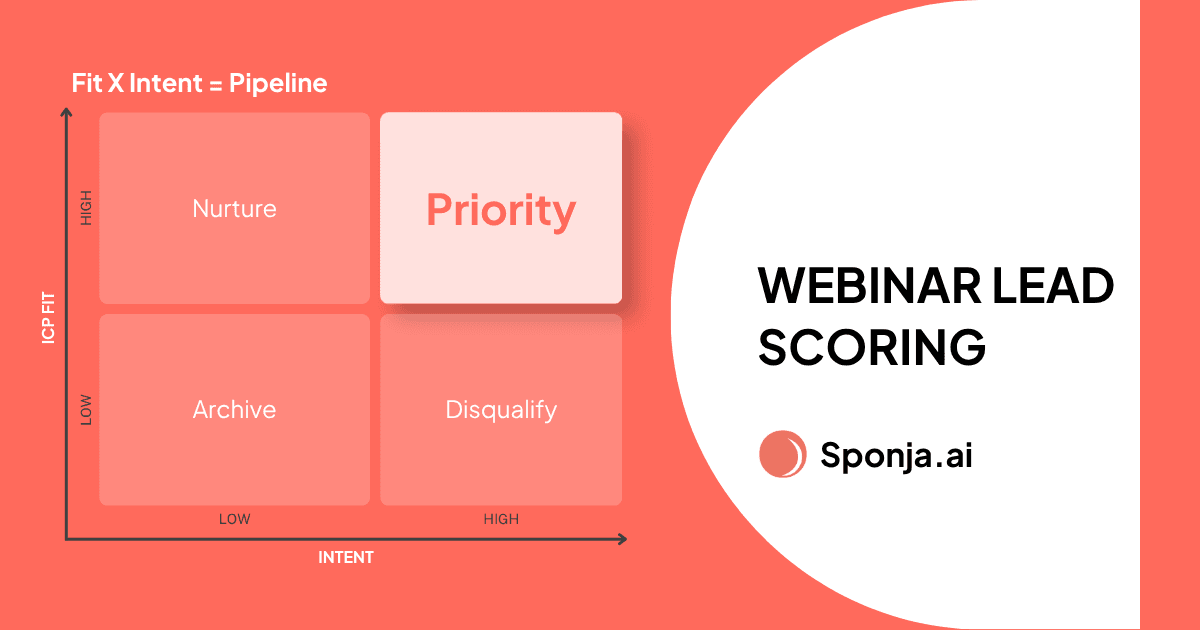
Webinar lead scoring is the practice of ranking each attendee by likelihood to become pipeline, using two inputs: how well they match your ideal customer profile and how they behaved in the session. Most teams score only the second half. They watch the chat, note who asked questions, and call the loud attendees hot. That misses the leads who quietly match your best customers and overrates engaged attendees who will never buy. The fix is to score fit and intent as two separate axes, then act on where they cross.
Key Takeaways
- Webinar lead scoring is ICP fit multiplied by in-session intent, not intent alone.
- High intent with low fit is a time sink for reps; low intent with high fit is a nurture miss. The matrix separates them.
- CRM firmographics plus LinkedIn enrichment supply the fit half that the webinar itself cannot see.
- Pipeline prediction comes from matching scored attendees against the profile of your closed-won deals.
- A score is only useful if it triggers action: a personalized email and a per-attendee data room routed to the assigned rep, sent the same day.
What is webinar lead scoring?
Webinar lead scoring assigns each attendee a priority based on two dimensions: fit and intent. Fit measures how closely the attendee and their company match your ideal customer profile, drawn from firmographics like industry, company size, and role. Intent measures in-session behavior: watch-time depth, the questions they asked, and the links they clicked. Strong B2B scoring models keep these two dimensions separate rather than blending them into one number, because a single blended score hides which half is driving it. As intent-data vendor Bombora notes, fit and intent answer different questions and should be scored independently.
The webinar is unusually good at measuring intent. An attendee who stays past the offer, asks a buying-shaped question, and clicks the pricing link is broadcasting where they are in the journey. But the room tells you almost nothing about fit. That is where lead scoring goes beyond pure webinar intent scoring: it pulls in who the attendee is, not just what they did. Score both, and the hottest attendee at a non-fit company stops jumping the queue.
Why in-session intent alone misclassifies your best leads
In-session intent alone overrates engaged non-buyers and overlooks quiet fits. The most active person in your chat is often a consultant, a student, or a competitor doing research. They will inflate your hot list every time if intent is the only axis. Meanwhile, a VP at an account that looks exactly like your last three closed-won deals may watch the whole session in silence and never type a word. Pure intent scoring buries that person.
The gap is firmographic. The webinar platform captures behavior but not company revenue, headcount, industry, tech stack, or the attendee's actual seniority. Registration forms try to collect this, but people lie, abbreviate, or use a personal Gmail address. To score fit honestly you have to enrich the attendee record against your CRM and external data. Without that layer, your scored list is half-blind, and the half it cannot see is the half that decides whether a lead is worth a rep's time. This is the same failure mode that breaks MQL to SQL conversion: marketing passes engaged leads that sales rejects because they were never a fit to begin with.
The fit x intent matrix: which attendees actually become pipeline
Plot fit on one axis and intent on the other, and every attendee lands in one of four quadrants. Each quadrant has a different next step, and only one of them earns a rep's calendar the same day.
| Quadrant | Fit | Intent | What it means | Action |
|---|---|---|---|---|
| Priority | High | High | Right company, leaning in | Route to assigned rep same day |
| Nurture | High | Low | Right company, quiet | Sequence, warm before sales touch |
| Disqualify | Low | High | Engaged, wrong fit | Send content, do not route to sales |
| Archive | Low | Low | Neither | Low-cost newsletter, no rep time |
The Priority quadrant is your predicted pipeline. The Disqualify quadrant is the one most teams get wrong: those engaged, non-fit attendees feel hot, so reps chase them and burn hours on deals that never had a chance. The Nurture quadrant is the one most teams miss entirely, because low intent makes high-fit accounts invisible to an intent-only model. Tracking conversion by quadrant across a few events tells you whether your fit and intent thresholds are calibrated. For the underlying behavioral metrics that feed the intent axis, see webinar analytics that predict pipeline.
How LinkedIn enrichment sharpens ICP fit
LinkedIn enrichment supplies the fit signals your CRM and registration form cannot. A CRM record goes stale the moment someone changes jobs, and registration forms rarely capture seniority accurately. Enrichment closes that gap by reading current, public professional data and attaching it to the attendee record before scoring runs.
The signals that move the fit axis most:
- Role and seniority: the difference between a "Marketing Manager" who registered and the VP who actually owns the budget.
- Recent job change: a new decision-maker in their first 90 days is often actively re-evaluating their stack.
- Hiring activity: a company posting roles in your buyer's function is usually expanding that function, a classic growth signal.
- Company trajectory: headcount growth, funding, or a new market all sharpen whether an account matches your ICP.
Layered onto the in-session intent, enrichment re-ranks the list. A quiet attendee whose company just raised a round and is hiring across the function moves up. A loud attendee at a company outside your size band moves down. The matrix gets more accurate the moment fit is built from live data instead of a form field.
From score to pipeline prediction: connecting the CRM
Pipeline prediction comes from comparing scored attendees against the shape of your past wins. Connect the scoring to your CRM and you can match each attendee's firmographics and behavior against the profile of deals that actually closed. Attendees who resemble your closed-won set and showed high in-session intent are your highest-probability pipeline; the model is essentially a closed-won lookalike weighted by fresh intent.
This is also where the score earns trust with sales. When the Priority list is built from the same firmographics that defined your last ten wins, reps stop second-guessing it. Over a few events you can attach a rough expected value to each quadrant by tracking how many Priority leads became opportunities and how many closed. That turns the webinar from a program whose ROI you have to defend into a forecastable pipeline source. The CRM connection is what makes the score predictive rather than just descriptive.
Acting on the score: personalized follow-up and a post-webinar data room
A score that does not trigger action is wasted. The signal decays fast, and buyers expect speed: Salesforce's State of Sales report found that the majority of customers now expect real-time responses when they reach out to a company. The scoring and the follow-up therefore have to fire the same day, while the webinar is still fresh in the attendee's mind.
Two outputs do the work:
- A personalized follow-up email. Tied to the attendee's score and behavior: a recap that references the questions they asked, one or two assets from your content library matched to their stage, and a next step sized to their quadrant. Salesforce's State of the Connected Customer research found that the large majority of business buyers expect vendors to personalize engagement to their needs, so a tailored message beats a batch blast by a wide margin.
- A per-attendee post-webinar data room. A single private page with a personalized recap, the most relevant content from your library, and a clear CTA that routes directly to the attendee's assigned rep. Because most B2B buying happens self-serve, with Gartner finding 61% of buyers prefer a rep-free experience, a data room lets a Priority lead keep moving on their own terms while keeping the rep one click away.
The Priority quadrant gets both, with the rep notified. The Disqualify quadrant gets the content but no rep handoff. Matching the output to the quadrant is what keeps reps focused on the leads worth their time.
The post-webinar scoring workflow, end to end
The whole loop runs in minutes, not days. Here is the sequence from session end to routed lead:
- Ingest the session: pull the attendee list, watch-time data, chat, questions, and link clicks.
- Score intent: rate each attendee on in-session behavior.
- Enrich and score fit: match each record to the CRM, layer LinkedIn enrichment, and rate ICP fit.
- Plot the matrix: combine the two axes and assign each attendee to a quadrant.
- Predict pipeline: rank the Priority quadrant against your closed-won profile.
- Trigger action: generate the personalized email and the per-attendee data room, and notify the assigned rep for Priority leads.
Run by hand, this takes a team the better part of a day per event, and the highest-intent leads cool before anyone reaches them. Automated, it finishes inside the same hour the recording releases. That speed is the whole point: webinar lead scoring only predicts pipeline if you act on the prediction before the signal fades. Sponja runs this entire loop automatically, scoring fit and intent, predicting pipeline, and producing the personalized follow-up and data room within about fifteen minutes of a session ending.
