
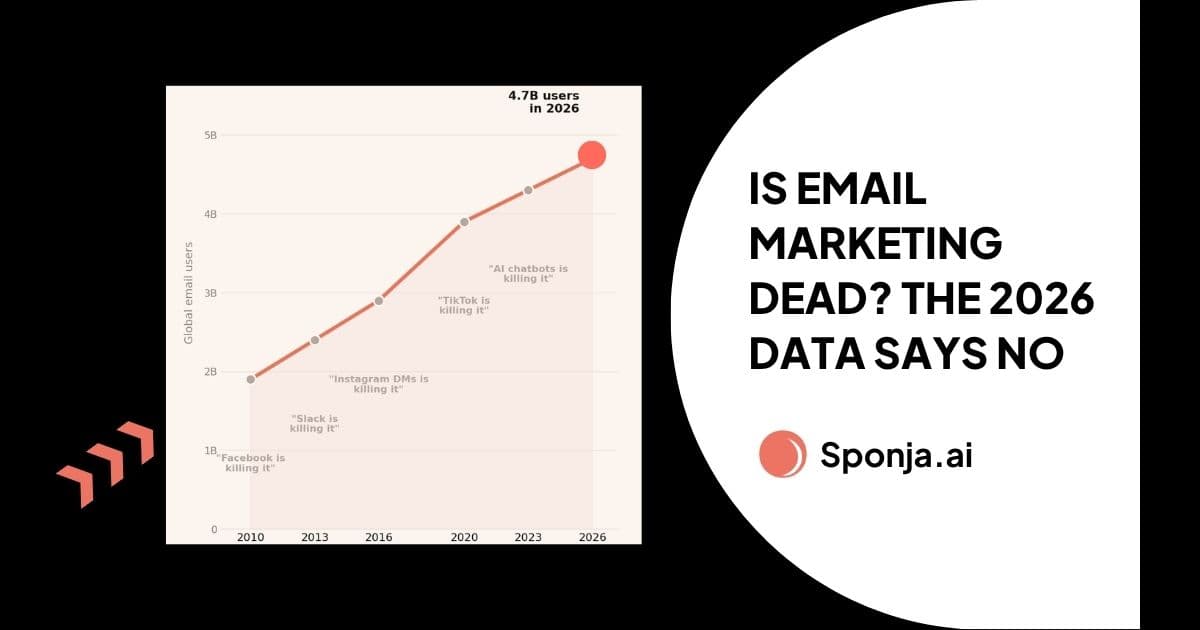
Email is not dead in 2026. It has 4.7 billion users, 392 billion daily sends, and the highest ROI of any marketing channel. The thing people keep mistaking for email's decline is the collapse of organic reach on platforms they never owned in the first place.
Key Takeaways
- Email has 4.7 billion users worldwide in 2026, roughly 57 percent of the planet.
- 392 billion emails are sent every day, growing about 4 percent a year.
- Email returns up to 42 dollars for every 1 dollar spent, the most-cited ROI of any channel.
- Facebook organic reach has fallen to under 2 percent of a Page's own followers.
- Email is the only channel you own outright: no algorithm, no platform risk, no pay-to-play.
- The highest-intent moment to use it is the 24 hours after a live event.
Is email marketing dead in 2026?
No. Email marketing is not dead, and every hard number says it is growing. There are 4.7 billion email users worldwide in 2026, according to the Radicati Group's Email Statistics Report, which is about 57 percent of everyone alive. Daily volume sits at 392 billion emails sent per day and climbs roughly 4 percent each year.
The ROI is the part marketers care about most. The widely-cited figure from Litmus and DMA research is up to 42 dollars returned for every 1 dollar spent. Reported averages range from about 36 to 42 dollars depending on the source, and even skeptical holdout-test estimates still beat paid social and display. Email is a 4.7-billion-user channel with the best return in the stack. That is not a dead channel.
"Email marketing is dead" is a myth. "Email marketing is not dead" is the data.
Most people who type "email marketing is dead" into search are not asking a question, they are looking for permission to stop sending. The instinct is understandable: inboxes are crowded, a single campaign gets ignored, and it feels like proof the channel is gone. It is not. Email marketing is not dead, it is saturated, and those are two different problems with two different fixes. A dead channel loses users and volume every year. Email added both again in 2026. What is actually dying is the generic blast: one body sent to a whole list on the sender's schedule instead of the reader's. Blasts are dying. Relevant, well-timed email is not, and the gap between the two is widening every year, not closing.
Every generation declared email dead
"Email is dead" is one of marketing's most reliable wrong predictions. Each new platform arrives, someone calls the funeral, and email keeps going up and to the right.
| Year | The "email killer" | What happened to email |
|---|---|---|
| 2010 | Kept growing | |
| 2013 | Slack | Kept growing |
| 2016 | Instagram DMs | Kept growing |
| 2020 | TikTok | Kept growing |
| 2023 | AI chatbots | Kept growing |
| 2026 | (next thing) | 4.7 billion users |
The pattern holds because email is infrastructure, not a trend. A new app competes for attention inside a feed it controls. Email sits on an open protocol that every other service still uses to verify you, reset your password, and confirm your purchase. You cannot kill the layer everything else is built on top of.
The channel you actually own
Here is what is genuinely dying: organic reach. Facebook now shows a typical Page post to under 2 percent of its own followers, with benchmarks landing between 1.37 and 2.6 percent depending on the study. In 2012 that number was 16 percent. You built the audience, and the platform decided you have to pay to reach it.
Owned media is any channel where you hold the audience relationship directly, with no intermediary deciding who sees you. Email is the clearest example. Your list is a file you can export, a relationship no algorithm can throttle and no acquisition can take away. The brands and creators who figured this out early are not chasing the next feed. They are compounding an asset nobody can revoke. Build the list, own the audience, and everything else is rented.
Where email matters most: right after a live event
Email earns its return most sharply in one window: the 24 hours after a live event. That is when attendee intent is highest. Someone who just sat through your webinar, workshop, or demo is closer to a decision than they will be at any other point, and a personal follow-up email is still what converts that moment into a reply. The return does not start at the follow-up either: a sharp webinar invitation email is what fills that room in the first place, so the same channel earns twice from a single event.
This is the bridge between the channel and the moment. A generic broadcast wastes the intent. The webinar attendee who asked two pricing questions and stayed past the offer needs a different email than the one who dropped off at minute ten. Our pillar guide to the webinar follow-up email covers the anatomy of a message that converts, and our follow-up email templates give you starting points by attendee type. The point is not to send more email. It is to send the right one while the window is open.
The bottleneck is volume, not the channel
If personal follow-up converts best, why do most hosts send one generic blast or nothing at all? Because writing 200 tailored emails by hand is the real bottleneck. The channel works. The labor does not scale.
That is the gap Sponja was built to close. It reads the event, scores every attendee from 0 to 100 on buyer intent, and drafts a follow-up in your voice for each person, so the channel you already own finally gets used the way it should. If you want to see how attendee-level scoring changes the math, the follow-up email generator is the fastest way to start, and platform-specific guides like our WebinarJam follow-up walkthrough show how it fits your existing stack.
Email is not dead. It is the most owned, highest-return channel you have, and it is most powerful in the hours right after you bring an audience together live. Build the list. Own the audience. Use it when intent is at its peak.
